
Chronic Pain: Why It Persists
— And What Most Treatments Miss
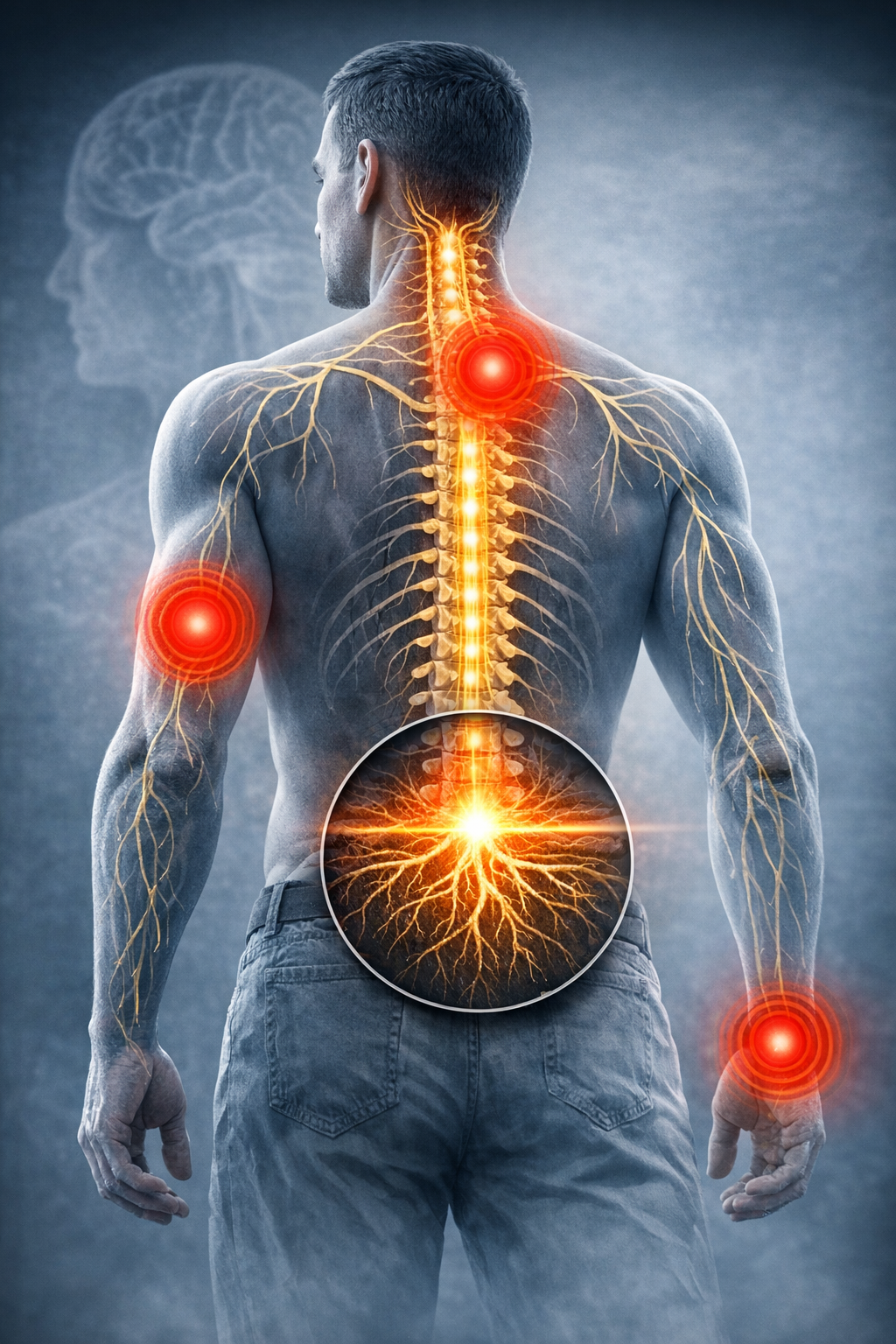
Most people dealing with chronic pain are not lacking effort.
They’ve seen specialists.
They’ve followed treatment plans.
They’ve done the exercises, taken the medication, and tried to stay consistent.
And yet…
The pain remains.
Or it improves temporarily, then returns.
This is where confusion begins.
Because if everything has been done “correctly,”
why does the problem still exist?
Discover:
chronic pain that won’t go away
root cause of pain
why pain keeps returning
WHAT CHRONIC PAIN ACTUALLY IS
Chronic pain is often approached as a local issue:
A shoulder problem
A lower back condition
A knee, neck, or nerve issue
But in many cases, the pain itself is not the problem.
It is the result of how the body has adapted over time.
Modern approaches increasingly recognise:
the role of the nervous system
movement compensation patterns
stress and load over time
previous injuries (even if long forgotten)
This is why many people experience:
recurring pain in the same area
new issues appearing after treating another
ongoing tightness, restriction, or imbalance
The body is not failing.
It is compensating.
WHY MOST TREATMENTS PLATEAU
Most treatment pathways are designed to:
reduce symptoms
improve function
manage flare-ups
And in many cases, they do help.
But there is a difference between:
relief
and
resolution
Relief reduces the intensity of the problem.
Resolution addresses why it keeps returning.
This is where many people get stuck:
treatment works… temporarily
pain returns under load, stress, or time
the cycle repeats
Not because the treatment is wrong.
But because something deeper has not yet been addressed.
THE MISSING LAYER
When pain does not resolve, it is often due to:
Structural compensation
How the body has physically adapted around previous issues
Neurological patterning
How the brain and nervous system have learned to move, protect, and respond
Unresolved load
Physical, emotional, or behavioural patterns held in the system over time
These do not always show clearly on scans.
But they show clearly in:
posture
movement
tension patterns
breathing
coordination
Until these are seen and corrected,
the body continues to repeat the same loop.
WHERE BODY INTELLIGENCE BEGINS
This is where a different approach is required.
Not more treatment.
Not more management.
But a clear understanding of how your body is actually functioning.
The Body Intelligence Method focuses on:
identifying the true source of strain (not just the symptom)
restoring structural alignment and balance
recalibrating how the nervous system controls movement
teaching you how to recognise and correct patterns yourself
This is not a passive process.
It is practical, hands-on, and educational.
The goal is not dependency.
The goal is independence.
CASE PATTERNS
Most people who arrive here have already tried multiple approaches.
Common patterns include:
Long-term lower back pain (5–20+ years)
Tried: physio, chiropractic, massage, medication
Result: temporary relief, recurring flare-ups
Finding: compensation from hips and thoracic restriction
Outcome: pain reduced significantly or resolved once full pattern corrected
Neck and shoulder tension with headaches
Tried: massage, stretching, posture correction
Result: short-term release, tension returns
Finding: breathing pattern + protective holding response
Outcome: tension released and no longer returns in the same way
Sciatica or nerve-related pain
Tried: standard therapy, rest, exercises
Result: ongoing irritation or flare cycles
Finding: structural compression caused by compensation patterns
Outcome: pressure removed at source, symptoms reduced or eliminated
High performers under constant load
Tried: regular treatment and recovery routines
Result: maintained but never fully clear
Finding: underlying inefficiencies in movement and recovery
Outcome: increased capacity, reduced breakdown, improved performance
Real-world examples of this can be seen in documented case studies.
WHO THIS IS FOR
This work is for people who:
have tried multiple approaches without lasting results
feel like something is being missed
are willing to understand their body, not just treat it
want resolution, not ongoing management
It is not for those looking for quick, passive relief alone.
Most approaches manage pain.
Some reduce it.
Very few address why it keeps returning.
That is the difference.
If you are still dealing with something that has not resolved,
the next step is simple.
Start with a short conversation.
We’ll look at what you’ve tried, what’s happening,
and whether this approach is the right fit.
Private. Direct. No obligation.